Showing posts with label field trips. Show all posts

Thursday, September 30, 2010

Chautauqua Institute: Map of the Holy Land

On our recent trip to Chautauqua, NY, we stopped over at the Chautauqua Institute. It was across the lake from us on beautiful Lake Chautauqua.

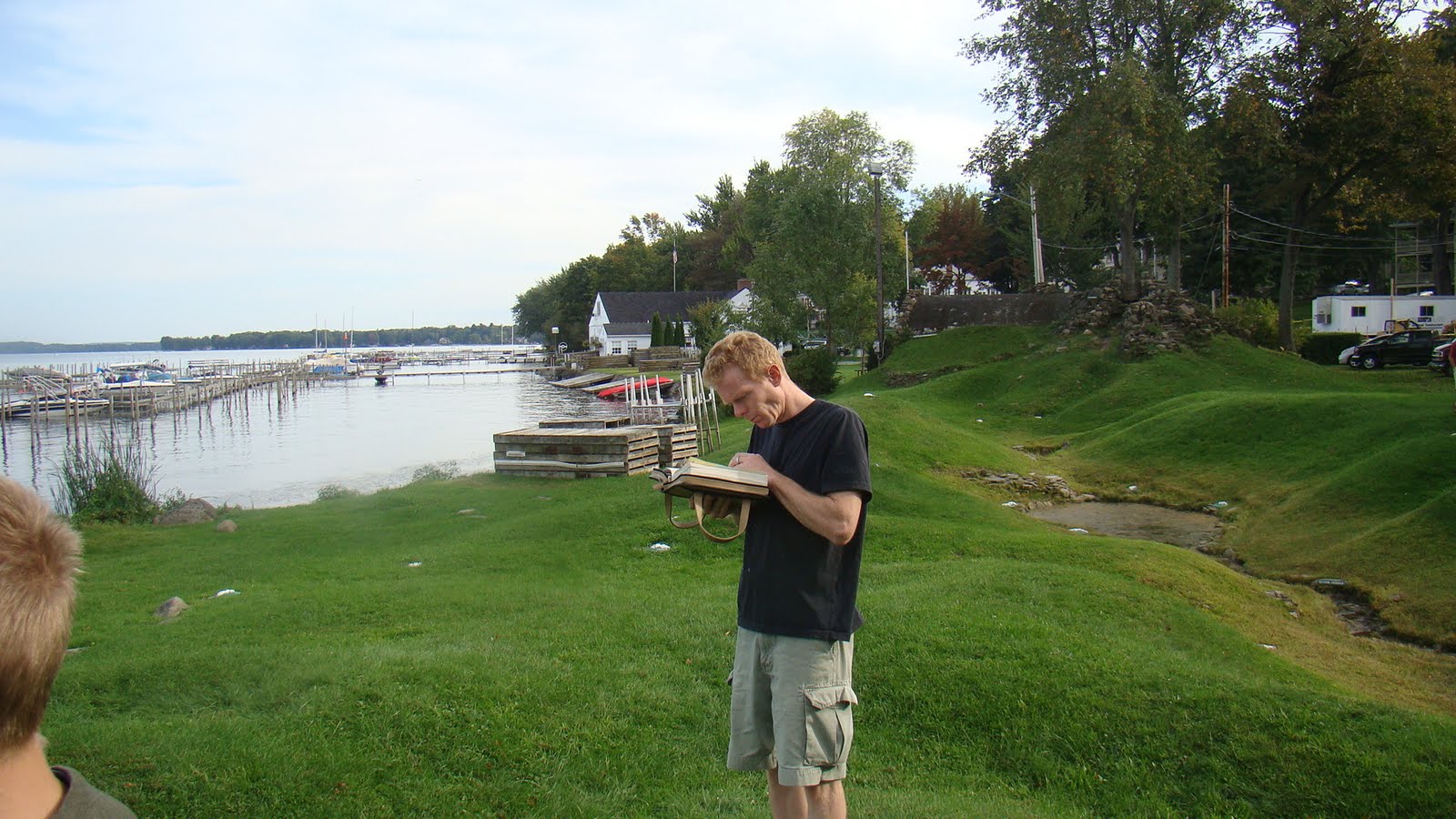
They have a very large map of the Holy Land, created to scale (1.75 feet= 1 mile) that was made in the late 1800's. They have maintained it ever since. The Chautauqua shoreline is used as the Mediterranean Sea. The above picture shows the Sea of Galilee closest, with the Jordan River headed away and in the distance is the Dead Sea. It was nice to be able to get a perspective on relative sizes. The white 'stones' in the grass were city markers.

Here, Thomas is checking out Jacob's Well. I was surprised to find it over a foot deep.

My DH took out his Bible maps to see where everything was supposed to be.
It helped to figure out where you were relative to everything else.

The towns were marked with these white stones that gave you an idea of their relative size.

They have carved hills and valleys that are accurate as well. This is just above the Dead Sea.

This plaque gives you some of the history of the site as well as information about the map.
You can see the Dead Sea right above the top of the plaque.

This was a free side trip. We probably spent about 45 minutes looking around. The children enjoyed it. It is worth stopping in, if you are in the area.
The Chautauqua Institute was started by the Methodists in the 1870's, I believe. It was part of the revival that took place in America after the Civil War. The gospel was preached and lives were changed. Since then it has become very ecumenical and has lost the message.
~Mom

Tuesday, September 7, 2010

McKinley Presidential Library and Museum, Canton OH

This is part 3 of our field trip, the unplanned part. After we struck out at Zoar Village, we had some extra time to do something else. We had seen the William McKinley Museum earlier and decided to go there and check it out. We had a great time.
We arrived there only an hour and a quarter before closing time. I asked the lady at the desk if we could see enough of the museum in that time and she assured me that it would still be worthwhile. This Library is not part of the Ohio Historical Society, so we had to pay admission. They charge $7 for adult, $6 for Seniors, and $5 for children. She did give me a discount based on the goodness of her heart and only charged me $22 to get our gang in, instead of $39. It does pay to ask. Incidentally, this library has reciprocal privileges with a number (over 300) of science museums.
We had a marvellous time! As we started into the museum we weren't sure where to start. We began wandering into the history section. Suddenly, an older gentleman, with a gleam in his eye and childlike enthusiasm, (and a guide badge on) accosted my children and wanted to show them all the neat things in the museum. It was a real blessing from the Lord! He demonstrated a number of different pictures on the stereoscope.

He showed us the 'transitional piano', one of only five in the whole USA. He played it and told us how it was the transition between the harpsichord and the piano. He told us the story of how this transitional piano was bought for a little boy's fifth birthday and cost his parents $1,000. Back when men were only earning a dollar a week. The gentleman also played an old Gramophone for us. We got to see and hear some neat things.

Then he took us to the vacuum powered lift chair. This portion of the museum was sponsored by local businesses and their products. (Hoover, in this case)

Timken, the bearing manufacturer, has sponsored the spinning tea cup for the children to ride in. It is to demonstrate how smooth their bearings are.

Since this is the William McKinley Museum, there are several displays dedicated to him. They have electronic robot reproductions of them that talk together and to the 'visitors'. They had his desk there and a number of other items and paintings. I also read that Mrs. McKinley took to making slippers after William died. I remembered that one of the items at the Hays presidential museum, was a pair of slippers made for him by Mrs. McKinley. Kinda neat.

Our guide took us into some of the exhibits that you were only to look at from the door and allowed us inside them to show us some of it up close and let us touch it. The museum tells as much about Canton OH, as President McKinley. They have a life sized village built, with all the stores and offices, of downtown Canton in the 1920s. They even had a fireman's pole for the children to slide down.

They have a huge model train display with the trains running. This set up is made of different scenes from the Canton area in the first half of the 1900's. It took eleven men five years to build it. (I think they may have only worked on it in their spare time.) It is pretty amazing. Our guide went to the control panel in the center and turned it all on for us to see. Our time was quickly running out so we needed to go down to the Science portion of the museum. (We had 19 minutes left until closing).

The Museum has a planetarium and a movie about McKinley that we didn't get to see. Not enough time. The Science Museum is in the basement. They had a dinosaur dig and ecological center with live reptiles. They also provided activities (scavenger hunts) for the children, but we had no time to check it out.

They had a number of different activities that are pretty common to science museums. The children liked the 'Shadow Catcher' exhibit. There were more exhibits that we liked, but we were really racing through at this point as they were announcing that the museum was closing in a few minutes (4 PM).

Outside of the Museum, is the Mckinley Memorial. The top is where they have buried President and Mrs. McKinley and the two of their daughters who died in infancy. There is a long stairway up to the Monument. The children counted 108 steps. It reminded me of the training scene in 'Rocky'. There were also some football players running up and down the steps to complete the image. T-Bob went up and down the steps several times.

If you are in the area, I would say that this is a great way to spend a few hours (2.5-3 to see everything). If you can find a tour guide to show you through, it is even better! It really was a blessing.
~Mom

Saturday, September 4, 2010

Dover Dam and Zoar Village

Continuing on with our field trip on Wednesday.... As we drove along SR 800 East we saw the Dover Dam.
It looked interesting, so we stopped and checked it out.

The top of the dam was about 50 feet above the river. We wondered if the river ever come anywhere near the top of the dam. That would really have to be some flood!!

The river is really low right now as we haven't had much rain here.

The boys checked out everything they could find to look at.
Mr. Boot said this was the favorite part of the day for him.
Sometimes a little spontaneity pays off.
Zoar Village was a bust for us.
I am sure that most of the time it is a great place to visit, however when we were there it was all closed up. Ugh!! Apparently they went on to their fall schedule on Sept. 1, which is weekends only. I should have done a bit more research. A booboo by Mom.

We could still see their gardens. We drove around the town and then went on.
~Mom

Friday, September 3, 2010

Schoenbrunn Village, New Philadelphia, OH

We took the first field trip of the year on Wednesday. We went down to Schoenbrunn Village. It is part of the Ohio Historical Sites, so we got in free with our membership. Otherwise it is $7 for adults and $5 for children. The weather was really hot, over 90 degrees, which is VERY unusual in Ohio, especially in September. The Village goes to Weekend only hours after Labor Day. We had the place to ourselves. They had a nice introductory video that gave the history, and then we took a self-guided walking tour.


The village was completely destroyed and was rebuilt after some archaeological digs were done. There are about 15 buildings that have been reconstructed as well as fences and gardens.

The houses are built where they found the stone foundations. The Village was a Moravian settlement of Christian American Natives. They left the tribal religion and reached out to those around them. There were several Moravian missionaries that lived here also.

The houses were small and the doors were short. During the summer and on weekends they have guides who do the re-enactments and demonstrations.

The Moravians were big into educating the Indians. They wrote textbooks and translated the Bible into the tribal language. The second biggest building in the village was the above school. At one point they had 100 children attending.

They had benches in the middle and desk tables attached to the outside walls.
The settlement ate a lot of corn and grew beans and melons.

This is 'Heaven's Acre'.
The burial ground for the town. Only baptized individuals could be buried here. They did bury both white and Indian side by side. The stones on the ground are the headstones.

The original church in the village held over 300 people. They held services here every morning and evening to teach the people.
In late 1776 they left the settlement and burned the church down so that it wouldn't be desecrated. They left the area because they were pacifists and they were caught in the fighting of the Revolutionary War between the British coming down from Fort Detroit and the Colonists coming up from Fort Pitt. Neither side appreciated the 'Christian' Indians.

Here is T-Bob wearing a Moravian Preacher hat.
We had a nice time and spent about 1.5 hours here. If the presenters had been demonstrating the candle making, and all the other colonial arts we could have spent more. There is a nice small museum at the entrance that gives more history and holds many of the artifacts they found while excavating their archaeological dig.
~Mom

Wednesday, July 21, 2010

Fort Meigs and the War of 1812

We are continuing our Ohio History via field trips 'program'. Today we went to Fort Meigs which was where the turning point battle in the War of 1812 occurred. Prior to the siege at Fort Meigs the US had lost nearly all the battles of the war. After that the tide went against the British and the US won.

Fort Meigs is the largest restored fort in the US. It is the size of over 8 football fields. It is in Perrysburg, OH.
We were blessed to be able to hook up with a tour of children from a day camp. The guide took us on a tour of the fort and also demonstrated how to shoot his gun. If you call ahead they will arrange a tour for you.

In the center of the fort is an obelisk that was built early in the 1900's as a memorial to all the men who died there. More men died from disease than from battle wounds. The area is right on the Maumee river and was very swamp like. In the spring of 1813 the mud came up to the men's knees.

They do have different displays and information in four of the blockhouses. It got us out of the sun. It was VERY hot today. (90+).

The breeze off the river was the only thing that made it tolerable. At least we didn't have to wear the linen shirt and pants, the wool vest and dark blue wool jacket of a regiment soldier. They wore the exact same uniform, summer and winter.

The inside of the block houses were painted white so that the light coming in the window was reflected. They were not allowed to use candles in them as there was so much gunpowder present.

Our guide shot his gun out the window. It really wasn't very loud as the explosion occurred at the end of the barrel which was outside. I was surprised how much light came in the loop windows.
The inside of the fort has a number of earth mounds that were built by the soldiers as a place for them to hide behind from the cannonballs. They actually built little shelters inside the mounds. The British called the Americans 'groundhogs' as they would pop up to check for incoming shells and then duck back down into their holes. Very few Americans were killed in the battle from British artillery.

Outside the fort is a very nice air conditioned museum. It describes the role of the fort in the War of 1812, artifacts they have found on the grounds, important men of the time and a memorial. I think you could go through the museum in 30-60 minutes depending on how much reading you want to do.

The museum and fort cost $8 for and adult and $5 for a child and children 5 and under are free. It is also free if you are a member of the Ohio Historical Society. It is open Wednesday through Sunday. It has many re-enactments and programs on the weekends. Check their schedule before coming.
I would say that the children found this a fascinating visit. They have talked about it pretty much non-stop since they came home (when they weren't arguing about who had dishes-ugh!). Younger children might be bored. There are not a lot of buttons to push or brightly colored displays in the fort. It is a mile walk through the fort. There is a smooth gravel path. It was a very informative afternoon.
~Mom

Monday, July 5, 2010

Rutherford B. Hayes Presidential Library and Residence

I had a friend tell me about a neat field trip she went to at Fort Meigs. It was used in the Battle of 1812. We like to go to different places for summer fun and learning excursions. I went on the internet and found that our desired location was closed Monday and Tuesday. In my on line hunting I found that an Ohio Historical Society family membership gives you free entrance in about 50 historical sites around the state as well as a magazine that covers Ohio history. It cost us $55 for the membership (it includes 2 adults and children under 18 in a household), and gave an additional $5 off for educators. What a great deal! I hope to use it several more times this summer and throughout the year.

We selected the Rutherford B. Hayes Library,residence, and Museum. This house was the home of the president and his family for quite awhile. His uncle had it built for him. When asked, He said he wanted a porch with a house attached. The house was added to three times. We had a very knowledgeable tour guide. She talked rather fast as she had so much information to
impart. You are not allowed to take pictures in the house. President Hayes lived here before and after his presidency. It has some of the most amazing woodwork I have ever seen. It has 18 bedrooms. Back them it was out in the country and guests would come and stay for a spell. The Hayes had 8 children, 5 who reached adulthood. It sounded like a very happy, busy family.

My friend Kay came with us. We toured the home first, and then the museum/library.

Outside the house, are the graves of Rutherford and his wife, and several other family members. Hayes fought in the civil war and was wounded 5 times. He moved up through the ranks and ended up as a general.


Behind the family cemetery were two small rocks that mark the spots where two of his favorite horses were buried. I think the children were more fascinated by the two simple rocks than the fancy burial vault.

The presidential library and museum contains a lot of information about his life and the house there on the property. They also had a good sized room that contained information on all the presidents and had some memorabilia that was either given to him by them or that he had collected. There were some interesting tidbits. He had also collected a lot of native American artifacts which are displayed. Some of his children's toys and wife's dresses are there as well .

In the basement there is a large collection of weapons and things collected by his grandson during the Boxer Rebellion in China. Mr. Boots found it quite fascinating. There was also a big room with displays on croquet and its history.

On the front lawn they had a croquet game set up. They also had another game set up that was a cross between croquet and golf.

It used colored soccer balls. The balls could be kicked or hit with over-sized mallets. The wickets were extra large too.

It was different than croquet in that everybody played the same wicket. You played teams. There was a good amount of strategy. It was a lot of fun.

They have tournaments here on the weekends. This site also fields an old-fashioned baseball team. Check their schedule for these games in the summer.
The Ohio Historical Society Membership was more than paid for with this one outing. It would have cost us $64 to go in with everyone. We are looking forward to going to Fort Meigs later this summer.
~Mom